

You’ve placed your chips, the cards are dealt, and the tension is high. You’re sitting on a solid 19—a hand that usually promises a win. The dealer flips their hole card and hits, landing right on 19 as well. The table goes quiet. The dealer taps the table, leaves your chips exactly where they are, and moves on to the next hand.
This anti-climactic moment is known as a push.
For new players, a push can be confusing. Did you win? Did you lose? Why are your chips still there? While it might feel underwhelming compared to the rush of a blackjack payout, a push is a vital part of the game that actually works in your favor by preserving your bankroll. It effectively hits the reset button on a round, allowing you to fight another day without financial loss.
Understanding the mechanics of a push—and distinguishing between a standard tie and the tricky “Push 22” rule—can save you frustration and help you choose the right tables. Here is everything you need to know about the tie that keeps you in the game.
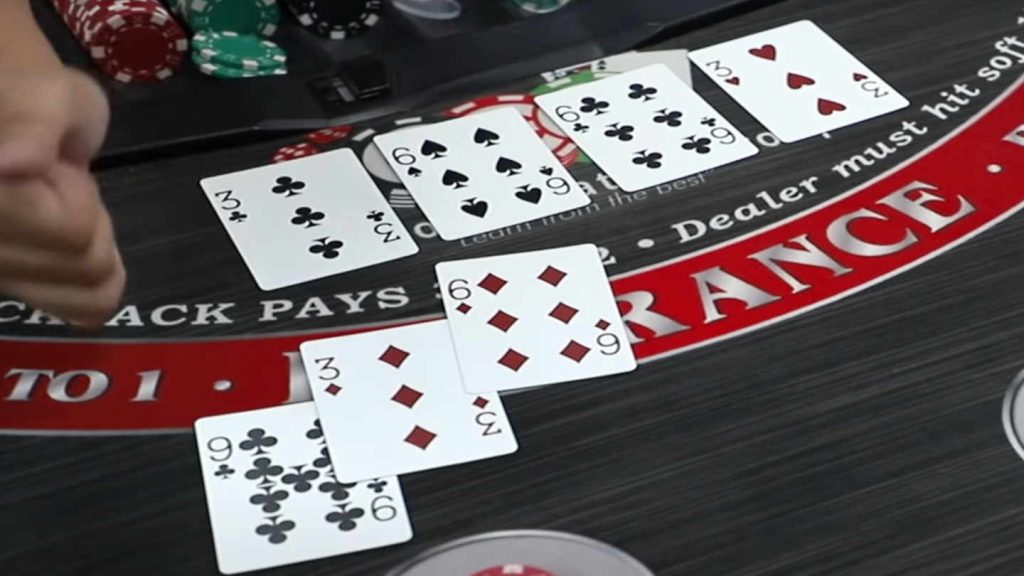
The Definition: What Exactly Is a Blackjack Push?
In the simplest terms, a blackjack push is a tie between the player and the dealer. It occurs when the final point value of your hand is identical to the dealer’s hand.
Because blackjack is a game played solely against the dealer (and not the other players at the table), their hand is the only one that matters in relation to yours. If you both finish with the same total, neither side wins. The house does not take your money, but you do not earn a profit. Your original wager is returned to you—or more accurately, it is simply left alone on the table for you to either take back or bet again in the next round.
For example, if you stand on a hard 18 and the dealer draws to 18, the round is a wash. It doesn’t matter how many cards it took to get there; the total point value is the deciding factor.
-
Welcome Bonus57,000 $/€ + 200 FS * Terms and conditions apply to all offers. Click on “Claim now” to get further details about the respective bonus.+12,000 games Strong and varied bonus Sleek visual design To Claim: Click Join NowGoldex CasinoJoin Now
-
Welcome Bonus19,000 €/$ + 300 FS * Terms and conditions apply to all offers. Click on “Claim now” to get further details about the respective bonus.+70 Game Companies Lucrative Promotions. Crypto compatibility To Claim: Click Join NowJoo CasinoJoin Now
-
Welcome Bonus4,500 €/$ + 300 FS * Terms and conditions apply to all offers. Click on “Claim now” to get further details about the respective bonus.Massive game library Generous, varied promotions Broad payment methods To Claim: Click Join NowSlotLords CasinoJoin Now



The Core Rules of a Push
While casinos may have slight variations in how they operate, the general rules regarding ties are consistent across most standard blackjack tables.
- Equal Value Equals Tie: If the player and dealer have the same total (e.g., 17 vs. 17, 20 vs. 20), no money changes hands.
- The “No-Result” Outcome: A push is statistically neither a win nor a loss. It does not affect your win/loss ratio, though it does extend your playing time.
- Hand Composition is Irrelevant: In most standard games, how you reached the number doesn’t matter. A 21 consisting of three 7s ties with a dealer’s 21 consisting of a 10 and a 6.
A Critical Exception: “Dealer Wins Ties”
While standard rules dictate that a tie returns the player’s bet, you must be vigilant when playing online or in tourist-heavy casinos. Some variations of the game declare that the house wins all ties. This rule massively increases the house edge and puts the player at a severe disadvantage. Always check the felt or the digital help section before sitting down; if the dealer wins on a push, you should find a different table.
The Math Behind the Tie: Probability Breakdown
How often will you actually see a push? If you are playing a standard single-deck game, the probability of any given hand resulting in a tie is approximately 8.5%. While this makes it a relatively rare occurrence compared to winning or losing, it happens often enough to impact your session.
Interestingly, the likelihood of a push changes depending on the value of the hand. High-value hands are far more likely to push than low-value hands because players and dealers both aim for high totals (17-21) and often stand once they reach them.
Here is the breakdown of push probability by hand value in a single-deck game:
- Total of 20: 2.5% (The most common push scenario)
- Total of 21: 2.3%
- Total of 19: 1.5%
- Total of 18: 0.7%
- Total of 17: 0.5%
- Natural Blackjack: 0.23% (The least common push)
As the data shows, you are most likely to tie on a 20. This makes sense strategically: 20 is a strong hand that players never hit, and dealers often arrive at 20 given the high density of 10-value cards in the deck. Conversely, a “natural” push (where both you and the dealer wake up with an Ace and a 10-card) is exceptionally rare.
Factors That Influence the Odds
While 8.5% is the baseline, external factors can shift these percentages slightly:
- Number of Decks: Generally, using fewer decks slightly increases the probability of a push.
- Soft 17 Rules: Tables where the dealer must hit on a soft 17 (an Ace and a 6) have a marginally higher rate of draws compared to tables where the dealer stands on all 17s.
Push 21 vs. Push 22: Knowing the Difference
This is where casinos can get tricky. It is essential to understand the difference between a standard push on 21 and the specific “Push 22” rule found in certain game variants.
The Standard Push on 21
This is the scenario we have discussed so far. You have 21, the dealer has 21. It is a tie, and you keep your money. This is fair play and part of the standard blackjack experience.
The “Push 22” Rule
You might encounter games like Free Bet Blackjack or Blackjack Switch. In these variants, the rules are tweaked to favor the house in a specific way. If the dealer busts with a total of exactly 22, it is not considered a dealer loss. Instead, it is counted as a push against all player hands still in play (except for natural blackjacks).
Under normal rules, if the dealer hits 22, they bust, and the table wins. Under the Push 22 rule, the dealer busts, but you don’t get paid—you only get your bet back.
While these variants often offer fun side bets or mechanics (like switching cards between hands), the Push 22 rule is mathematically unfavorable for the player. It can increase the house edge significantly—adding as much as 6.91% to the casino’s advantage in some contexts. If your goal is the best possible odds, avoid tables with the Push 22 rule.
-
Welcome Bonus 4,000 €/$ + 200 FS * Terms and conditions apply to all offers. Click on “Claim now” to get further details about the respective bonus.Join Now
-
Welcome Bonus 15,000 €/$ + 350 FS * Terms and conditions apply to all offers. Click on “Claim now” to get further details about the respective bonus.Join Now
-
Welcome Bonus up to 25,000 €/$ * Terms and conditions apply to all offers. Click on “Claim now” to get further details about the respective bonus.Join Now



Strategic Tips for Handling Pushes
You cannot force a push, but understanding that it is a possibility should influence how you manage your game and your mindset.
1. Don’t Fear the Tie
Some players get frustrated by pushes, feeling like they wasted their time. Change your perspective: a push is a “save.” In a game designed with a house edge, any result where you don’t lose money is a partial victory. It keeps your bankroll intact and allows you to play longer, earning more “comps” or waiting for a hot streak.
2. Stick to Basic Strategy
The possibility of a push shouldn’t cause you to deviate from basic strategy charts. For instance, knowing when to stand on a 12 or when to hit on a soft 17 is calculated to maximize your wins and minimize losses over time. The 8.5% push rate is already baked into these mathematical strategies.
3. Risk Management
If you have a hand of 19, you might be tempted to hit to try and get 20 or 21 to beat a dealer showing a 9. However, the risk of busting is high. Accepting that a 19 might result in a push (if the dealer also has 19) is better than busting and guaranteeing a loss. Play the percentages, not the exceptions.
Summary
A push in blackjack is simply a reset button. It occurs when you and the dealer finish with the same hand total, resulting in your bet being returned. While it lacks the excitement of a win, it is a crucial mechanism that protects your bankroll from the dealer’s strong hands.
However, not all pushes are created equal. Be wary of “Push 22” variants that rob you of a win when the dealer busts, and always check the table rules to ensure ties don’t go to the house. By understanding these nuances, you can approach the table with confidence, knowing that sometimes, breaking even is part of the path to winning.