
Walk onto any casino floor—whether it’s the plush carpet of Las Vegas or the digital lobby of an online site—and you’ll find two giants dominating the scene: Blackjack and Poker. They are the titans of the table games, yet they attract vastly different types of players.
Choosing between them isn’t just a matter of flipping a coin. It’s a choice between playing against the house or battling other players. It’s the difference between memorizing a rigid mathematical chart and mastering the subtle art of psychological warfare. While Blackjack offers a lower barrier to entry and a more relaxed pace, Poker promises the potential for massive earnings—if you have the steel nerves and the bankroll to support it.
If you’re standing at the crossroads of these two iconic games, wondering where to place your chips, this guide is for you. We’re breaking down the odds, the profitability, and the skill sets required for each, so you can decide which game truly belongs in your repertoire.
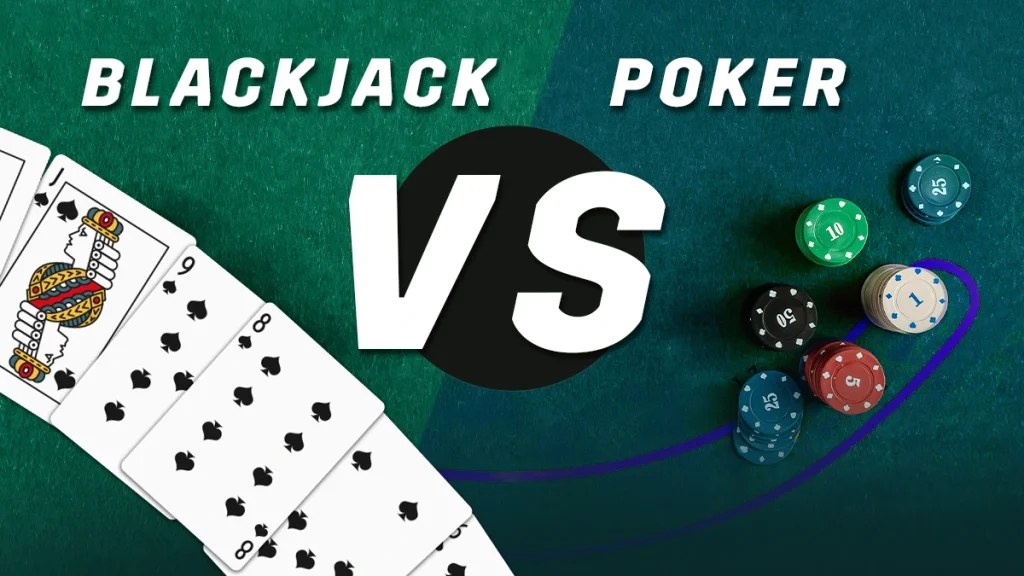
The Core Differences: Strategy vs. Psychology
At a glance, both games involve cards, chips, and green felt. But dig a little deeper, and you’ll find that the mechanics driving them are worlds apart. The fundamental divide lies in who you are fighting and how you fight them.
The Lone Wolf vs. The Social Chameleon
In Blackjack, your world is small. It’s you against the dealer’s upcard. While other players might be sitting at the table, their cards don’t directly impact your objective: beat the dealer without busting. You can be entirely anti-social, barely looking at your neighbors, and still play a perfect game.
Poker is the opposite. It is inherently a social battlefield. You aren’t just playing your cards; you are playing the person across from you. You need to read body language, detect bluffs, and manipulate the emotional state of your opponents. If you lack social intuition or the ability to read people, you are starting with a significant handicap.
Rigid Math vs. Creative Deception
Blackjack rewards obedience. There is a mathematically “correct” move for every single hand combination. If you have a 16 and the dealer shows a 7, the chart tells you to hit. Deviating from “Basic Strategy” usually results in losing money over the long term. Creativity is not an asset here; discipline is.
Poker rewards adaptability. There is no single chart that tells you what to do. Sometimes the best move is to fold a strong hand because you sense a trap; other times, the best move is to go all-in with nothing but air because you sense weakness. You must be willing to deceive, aggressive one moment and passive the next.
-
Welcome Bonus200% up to 10,000 USDT + 50 FS + 5 USDT Sports Bet * Terms and conditions apply to all offers. Click on “Claim now” to get further details about the respective bonus.+5000 games VIP program Crypto Payments To Claim: Click Join NowCryptoCasino.comJoin Now
-
Welcome Bonus15,000 €/$ + 350 FS * Terms and conditions apply to all offers. Click on “Claim now” to get further details about the respective bonus.15,000+ slots Supports Cryptos Daily cashback To Claim: Click Join NowJet4bet CasinoJoin Now
-
Welcome Bonus19,000 €/$ + 300 FS * Terms and conditions apply to all offers. Click on “Claim now” to get further details about the respective bonus.+70 Game Companies Lucrative Promotions. Crypto compatibility To Claim: Click Join NowJoo CasinoJoin Now



Analyzing the Odds
If you approach gambling from a purely statistical standpoint, the two games offer very different propositions.
The House Edge in Blackjack
Blackjack is famous for having some of the best odds in the casino—provided you know what you are doing. The “House Edge” is the statistical advantage the casino holds over the player.
- For the Amateur: If you play by “feel” without knowing the rules, the house edge can be as high as 4%. That means for every $100 you bet, you are statistically likely to lose $4.
- For the Strategist: If you memorize Basic Strategy and play perfectly, you can whittle that edge down to around 0.5%. This makes it one of the “fairest” games on the floor, but remember: the house still expects to win in the long run.
The Fluid Math of Poker
Poker odds are far more complex because the house doesn’t care who wins. In Poker, the casino makes its money by taking a “rake”—a small percentage of the pot or a tournament entry fee. They don’t have a statistical edge in the game itself; they just rent you the chair.
Your odds in poker are dynamic. They depend entirely on the skill gap between you and your opponents.
Win Rate: You cannot easily calculate your odds of winning the session because human behavior is unpredictable. If you are a shark playing against minnows, your odds are fantastic. If you are a minnow playing against sharks, your odds are terrible.
Pot Odds: You can calculate the likelihood of hitting a Flush or a Straight (the math is set in stone).
Featured Casino
Koru Casino
Sign up bonus
15,000 €/$ + 350 FS
* Terms and conditions apply to all offers. Click on “Claim now” to get further details about the respective bonus.
The Learning Curve
Blackjack: The Sprint
Blackjack is undoubtedly the easier game to learn. The rules are simple, the objective is clear, and the strategy can be printed on a business card. You can sit down at a table with zero experience, ask the dealer for advice (they will usually help you!), and have a reasonably good time. Once you memorize the chart, you have essentially “solved” the game for casual play.
Poker: The Marathon
Poker is easy to learn but impossibly hard to master. You can learn the hand rankings (a Flush beats a Straight, a Full House beats a Flush) in five minutes. However, understanding pot odds, position play, implied odds, and bluffing frequencies can take years.
Furthermore, because you are playing against humans, the “meta” of the game changes. Strategies that worked ten years ago might be obsolete today. To be a profitable poker player, you must be a student of the game forever.
Profitability: Where is the Real Money?
This is usually the deciding factor for serious gamblers. Where is the ceiling?
The Limits of Blackjack
In Blackjack, you are grinding against a small negative edge. You might go on a hot streak and win big in the short term, but the math dictates that the longer you play, the more likely the casino is to win its money back.
- Card Counting: The only exception is card counting, which can flip the edge in your favor. However, casinos are experts at spotting counters and will swiftly ban them. For 99% of players, Blackjack is not a career; it’s entertainment.
The Unlimited Potential of Poker
Poker is a game of profitability. Because you are playing against other players’ bankrolls, not the casino’s treasury, the sky is the limit.
High Stakes: The world’s richest professional gamblers are almost exclusively poker players. Tournaments offer multi-million dollar prize pools, and cash games can see hundreds of thousands of dollars change hands in a single evening.
Skill Gap: If you are consistently better than the people you play with, you will make money over time.
-
Welcome Bonus 4,500 €/$ + 300 FS * Terms and conditions apply to all offers. Click on “Claim now” to get further details about the respective bonus.Join Now
-
Welcome Bonus 15,000 €/$ + 350 FS * Terms and conditions apply to all offers. Click on “Claim now” to get further details about the respective bonus.Join Now
-
Welcome Bonus 15,000 €/$ + 350 FS * Terms and conditions apply to all offers. Click on “Claim now” to get further details about the respective bonus.Join Now


Which Game Should You Choose?
Choose Blackjack If:
- You prefer simple, structured decision-making.
- You want strong odds with minimal study.
- You enjoy a relaxed, low-interaction environment.
- You’re playing primarily for entertainment.
Choose Poker If:
- You are competitive and enjoy strategic battles.
- You’re comfortable reading and manipulating opponents.
- You’re willing to study and improve long-term.
- You want the possibility of turning skill into profit.
Whether you choose the disciplined grind of the Blackjack table or the psychological warfare of the Poker room, understanding the mechanics of your chosen game is the first step toward walking away a winner.