

When most people hear the phrase “card counting,” their minds immediately jump to scenes from Hollywood movies. They picture a genius sitting at a Blackjack table, mentally tracking every card in the shoe to bankrupt the casino, only to be dragged into a back room by security. It’s a dramatic image, but it has very little to do with how card counting actually works in the world of poker.
While counting cards is most famous in the realm of Blackjack, the concept applies heavily to poker, though the mechanics are entirely different. In poker, you aren’t trying to beat the house; the house takes its rake regardless of who wins. Instead, you are trying to gain a mathematical edge over your opponents.
Learning to count cards in poker—specifically in Texas Hold’em—is less about memorizing a six-deck shoe and more about understanding probability, blockers, and equity. It is a skill that transforms poker from a game of chance into a game of calculated risk. If you are ready to move beyond “gut feelings” and start playing with mathematical precision, you need to understand the mechanics of counting.
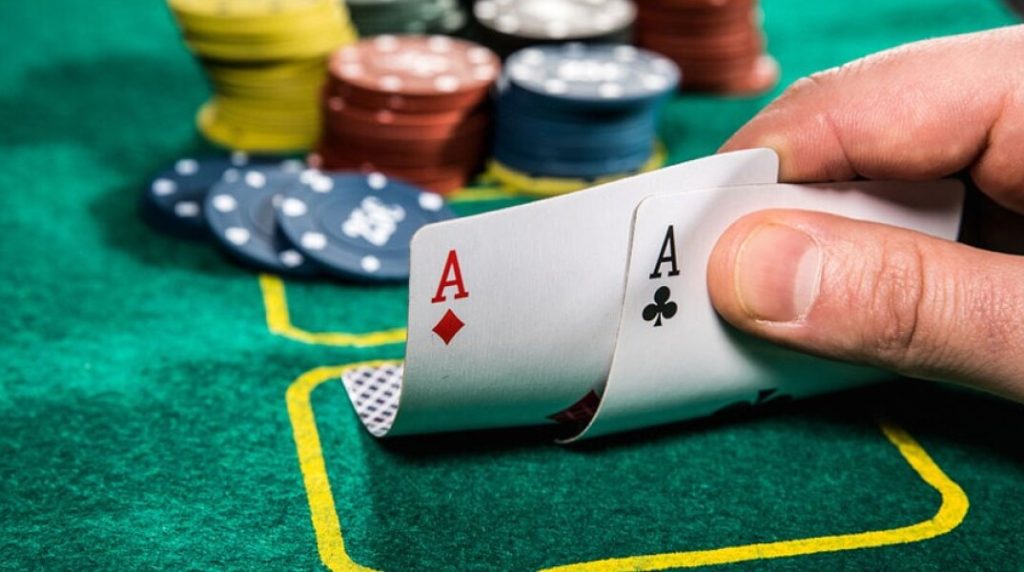
The Difference Between Blackjack and Poker Counting
To understand how to count cards in poker, you first have to unlearn what you know about Blackjack. In Blackjack, the deck (or shoe) is not shuffled after every hand. This means that if a lot of face cards were played in the previous round, the remaining deck is rich in low cards. A player “counts” to know when the probabilities have shifted in their favor against the dealer.
Poker is different. In online poker and most land-based casinos, the standard 52-card deck is shuffled before every single hand. What happened three hands ago has zero statistical bearing on the cards being dealt right now.
Therefore, “counting” in poker doesn’t refer to tracking the deck over an hour of play. Instead, it refers to tracking the known variables during a specific hand to determine what cards remain in the deck (the “unknowns”). By deducing what cards your opponents might be holding based on the community cards and your own hole cards, you can make profitable decisions that exploit their weaknesses.
Understanding Poker Equity
At the heart of card counting is the concept of equity. Simply put, equity is your probability of winning the pot at any given moment, assuming all players go all-in and see the remaining cards. It is essentially your “ownership share” of the money in the middle of the table.
Calculating equity helps you decide whether a bet is worth calling. If your equity is higher than the odds the pot is offering you, calling is a profitable long-term play. If it’s lower, you should fold.
The All-In Scenario
Let’s look at a classic pre-flop scenario to visualize this. Imagine you are holding a pocket pair of Fives (5h and 5c). Your opponent holds Big Slick—an Ace of Hearts (Ah) and a King of Hearts (Kh). You both go all-in before the flop.
Who has the advantage?
Many novices assume the Ace-King is better because the cards are higher. However, the pocket Fives actually have higher equity (roughly 52% to 54% depending on suits). This is because the Fives are already a “made hand”—a pair. The Ace-King must hit the board to win. By understanding this, you count the strength of your hand relative to the probable range of your opponent’s hand.
The “Blocker” Strategy in Texas Hold’em
In Texas Hold’em, the most effective form of card counting is often referred to as using “blockers.” This is the process of looking at the cards you hold to determine what your opponent cannot have.
When you hold a specific card in your hand, you effectively remove it from the deck. This changes the mathematical probability of your opponent holding certain winning combinations.
-
Welcome Bonus up to 25,000 €/$ * Terms and conditions apply to all offers. Click on “Claim now” to get further details about the respective bonus.Join Now
-
Welcome Bonus 15,000 €/$ + 350 FS * Terms and conditions apply to all offers. Click on “Claim now” to get further details about the respective bonus.Join Now
-
Welcome Bonus 57,000 $/€ + 200 FS * Terms and conditions apply to all offers. Click on “Claim now” to get further details about the respective bonus.Join Now



A Practical Example
Let’s say the board runs out with four cards: Jack of Hearts (Jh), 9 of Hearts (9h), 6 of Hearts (6h), and a 5 of Spades (5s).
The board is terrifying because there are three hearts showing. A Flush is a very real possibility. Your opponent makes a massive bet, representing that they have the Flush.
However, you look at your hand and see you are holding the Ace of Hearts (Ah) and the King of Clubs (Kc).
Because you hold the Ace of Hearts, you are “blocking” the Nut Flush. It is physically impossible for your opponent to have the best possible flush because the key card required to make it is sitting in your hand. While they might still have a lower flush (like a Queen-high flush), you have successfully “counted” the Ace out of their range. This information allows you to bluff, call, or fold with much higher confidence.
Is Counting Cards in Poker Legal?
This is the most common question players ask, usually stemming from the stigma associated with Blackjack. The short answer is: Yes, card counting in poker is 100% legal.
In fact, it is not just legal; it is encouraged.
The reason Blackjack card counters get banned is that they are gaining an edge over the casino (the house). Casinos are private businesses that can refuse service to anyone hurting their profit margins. In poker, however, you are not playing against the casino. You are playing against other players. The casino takes a fixed percentage of the pot (the rake) regardless of who wins.
Using your brain to calculate odds, track outs, and deduce holdings is the definition of skill in poker. As long as you aren’t using an external device, you are simply playing a smart game.
-
Welcome Bonus15,000 €/$ + 350 FS * Terms and conditions apply to all offers. Click on “Claim now” to get further details about the respective bonus.Massive welcome bonus Regular reloads, cashback Extensive game selection To Claim: Click Join NowKoru CasinoJoin Now
-
Welcome Bonus4,500 €/$ + 300 FS * Terms and conditions apply to all offers. Click on “Claim now” to get further details about the respective bonus.Massive game library Generous, varied promotions Broad payment methods To Claim: Click Join NowSlotLords CasinoJoin Now
-
Welcome Bonus15,000 €/$ + 500 FS * Terms and conditions apply to all offers. Click on “Claim now” to get further details about the respective bonus.Massive welcome package Crypto for fast cashouts. Good live casino selection To Claim: Click Join NowRetroBet CasinoJoin Now


3 Essential Tips for Counting Cards
1. Master “The Outs”
An “out” is any unseen card left in the deck that will improve your hand to a likely winner. Counting your outs is the most basic and essential form of card counting.
If you have two hearts in your hand and there are two hearts on the flop, you can see four hearts total. There are 13 hearts in a deck, which means there are 9 hearts remaining. You have 9 “outs” to hit your flush.
2. Calculate Pot Equity vs. Pot Odds
Once you know your outs, you need to weigh them against the cost of the bet. If your chance of winning is lower than the price you’re being offered, the math says you should fold. Over time, making correct mathematical decisions is what makes winning players profitable.
3. Practice Deck Awareness
The standard 52-card deck is predictable. Good players practice by running scenarios and memorizing probabilities. Over time, you develop an intuitive sense for how likely certain hands are, allowing you to play confidently without slow mental math.
Transforming Your Game
Counting cards in poker isn’t about pulling a fast one on the casino. It is about removing the mystery from the game. By understanding that every card you see reduces the variables in the deck, you gain a massive strategic advantage over players who rely on luck.
It takes time to master equity calculations and blocker identification, but the payoff is significant. The next time you sit down at the table, stop looking for physical tells and start counting the possibilities. That is where the real edge lies.